
"What I like to do is to play with photography, to use it as an outlet for story telling and visual poetry. I don’t want to be tied down to one way of taking or processing images—I prefer being free to bend the rules of photography and take it wherever it will go. I like to think of myself as an experimental photographer. "
- Aliza Razell
Aliza Razell is a contemporary mixed media artist whose work merges photography and painting, most commonly watercolour. Her practice sits at the intersection of photographic realism and paint style abstraction, using the camera as a tool for documentation while allowing paint to function as an expressive, emotional, and symbolic intervention. Through this combination, Razell challenges the idea that photography alone can fully communicate internal experinece, instead presenting images that operate simultaneously as evidence and interpretation.
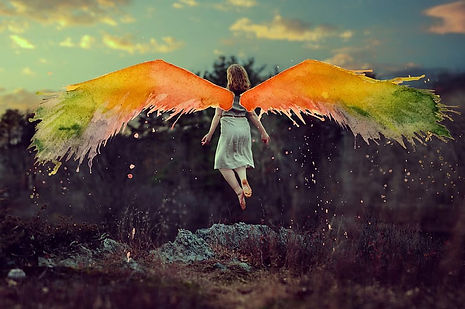
Razell's photography often centers around portraiture, which provides a sense of realism. Photography traditionally implies truth, presence, and a captured moment in time, however, Razell resists allowing the photograph to remain a closed or complete statement. By layering paint directly over the image, she interrupts its sense of documentation. Introducing a deeper layer of ambiguity, emotion, and subjectivity not previously visible. This encourages the viewer to question what is being seen verses what is being felt.
Technically, the contrast between photography and paint is essential to the success of her work. Photography is preise, mechanical, and instantaneous, whereas watercolour is unpredictable, fluid, and shaped by time and chance. The bleeding, blooming, and uneven edges of watercolour introduce a lack of control that directly opposes the camera's clarity. This tension becomes a part of the meaning, the paint often appears to represent emotions, memories, or psychological states that cannot be fixed or sharply defined. Rather than functioning as decoration, the painted layer acts as a visual language for what the photograph alone cannot contain.
Razell frequently uses muted or monochrome photographs as a base, allowing the paint to carry the emotional weight of the image. The separation forces the viewer to distinguish between the physical reality of the subject and the internal or emotional reality suggested by the paint. In some works, the paint partially obscures faces or bodies, creating a sense of concealment and vulnerability. In others, it extends beyond the subject, implying an emotional overflow or presence that exceeds the physical form. In both cases, the image exists in a state of partial visibility, where something is simultaneously present and withheld.
Conceptually, Razell's work aligns with themes of memory, impermanence, and emotional residue. Photography captures a fracture of a second, while painting implies revisiting and reworking that moment. The final image therefore contains multiple layers - the instant the photograph was taken and the extended time spent responding to it through paint. This layered time mirrors how memory operates - factual but altered, anchored in reality yet reshaped by responding through emotion and hindsight.
This approach directly links to my own project which explores absence, presence, and obscured clarity. Like Razell, I am interested in creating images that suggest something has occured without showing it explicitly. Where Razell uses paint to interrupt photographic certainty, I have used environmental conditions such as fog, silhouettes, and double exposures to limit visibility while maintaining focus. However, I plan on using Razell's work directly as inspiration and exploring the idea of adding a physical layer of manipulation to my images to emphasise the idea of resisting immediate comprehension and to push me out of my comfort zone and experiment with a new medium.

"Aliza Razell creates beautiful narratives in her mixed-media photographs by combining self-portraits with splashes of color to produce strange and mystifying images that cannot fully be explained.”
- My Modern Met
“I find the bright colors and how the artist leaves the viewer to interpret and create their own story within these pieces.”
- Ambience of Existence

In this image, Razell combines a monochrome photographic portrait with a vivid painted hand that extends from the subject's own. The photograph shows a partially obscured figure, cropped so the face and left half of the body is on the edge of the frame - immediately reducing personal identity and places emphasis on the gesture centered in the frame rather than the expression. The neutral tones of the photograph create emotional distance and a sense of stillness, reinforcing the idea of restraint and realism.
In contrast, the painted element is highly saturated and dynamic. The blue and purple watercolour appears to emerge from the subject's hand, splintering outward with uncontrolled edges and visible drips. This lack of control contrasts sharply with the precision of the photograph, suggesting that the paint represents something intangible such as emotion, memory, or connection. The paint behaves almost like a second figure, visually "holding" the subject's hand, which implies presence without physical form.
The use of colour may also be an intentional engagement with colour theory, where the blue and purple tones are commonly associated with introspection, melancholy, calm, and emotional depth. By introducing these colours through paint rather than through the photograph itself, Razell may be communicating emotion in a non literal way, allowing colour to act as a psychological language rather than a descriptive one.
The interaction between the hand and the paint creates tension between absence and connection, Although no second person is photographes, the composition strongly suggests relationship and touch. This use of mixed media allows Razell to visualise something that cannot be photographed directly, reinforcing the idea that photography alone is insufficient to convey emotional experience.
The photograph's shallow depth of field further reinforces the theme of partial presence, as the subject is isolated from their environment, with surrounding detail softened and made indistinct. This selective focus directs attention to the hand while limiting contextual information, mirroring the idea of emotional clarity existing alongside situational uncertainty.