Cindy Sherman is a successful contemporary artist, born in 1954, her work has remained as some of the most influential pieces in her genre. Specifically, she has shown the representation of identity inspired by a variety of movies, tv shows, artworks, and more. Working as her own model, Sherman produces cinematic images of different ‘characters’, all representing different identities and stereotypes.
In addition to being her own model, Sherman also acts as “makeup artist, hairdresser, stylist, and wardrobe mistress.” As well as the obvious role of photographer. Sherman uses equipment including - mirrors, cameras, and backdrops - to create her self-portrait style work. Using makeup, wigs, and clothes to transform her into different characters and personas.


A film still is a single frame taken from a film or an image staged to look that way. Usually, to capture the essence of a scene, mood, or character without showing the whole story.
Sherman's work with film stills exposes cliches and female stereotypes solidified through film and media. Including personas such as 'secretary', 'housewife', 'sad starlet', and more, Sherman emphasises the collective image we have as a society of women in these roles, drawing inspiration from 1950s/60s Hollywood cinema. The stills never offer a full story, we are dropped into the middle/end of a moment, ultimately, leaving the viewer with more questions than answers. This ambiguity is powerful, drawing viewers in to create their own narrative of what happened before or after the photo was taken and therefore one of the reasons her work is so successful in the storytelling and film still genre. Additionally, this obscurity ironically highlights her theme of identity, resembling how women's identities were left undeveloped beyond their archetypal roles.
This kind of work is ultimately fuelled by the instinct of projection, our tendency as viewers to insert our own histories, beliefs, and cultural knowledge into a story. Whether it be a written novel or a film still like Sherman's, meaning is never fixed. Each story is inferred differently depending on the eye that is looking at it. Ultimately, making interpretation less about what is shown and more about what viewers bring to it.

In this photo titled 'Untitled film still #48' Sherman has achieved a particularly interesting point of view, as the camera is seemingly positioned at eye level. This is effective as it feels as if the viewer is there with her, it also creates a sense of danger and vulnerability as it looks as if we are standing behind her with unknown intentions. Additionally, the wide angle also emphasises the vast landscape, making Sherman look smaller in comparison - mirroring her little power and control as a woman standing on the side of the road. Accentuated by the use of a wide depth of field, every level of the image is in focus and providing details and removing any intimacy, making the space around her feel limitless and overwhelming.
The road marking acting as a leading line, effectively creates a journey for the viewer to the image's vanishing point. Meeting with the vanishing point of the horizon line and the cliff, these elements add a sense of structure to the image while simultaneously allowing for more questions as to where does the road lead? Or who is around the bend, if anyone? The black and white filter successfully resembles the tone of a film scene from the 1950s/60s time period and works well in reinforcing the trope that Sherman is trying to achieve.
Shermans body language and what that represents is up for interpretation. In my opinion, her hands behind her back, straight posture, and gaze casting away from the camera alludes to a feeling of danger and vulnerability as though she is waiting for something, or someone, beyond her control. The ambiguity of denying the viewer eye contact, reinforces this as we get a sense that she isn't aware of what is happening around/behind her, heightening the unsettling mood.
Sherman's selection of props and clothing is central to how this image communicates. Her long skirt, blouse, and pinned back hair allow us to recognise her as a mid-century woman - particularly one appearing as modest, respectable, and conventional. The suitcase at her feet heavily adds to the narrative of travel, and uncertainty, forcing the viewer to imagine what she is escaping to, or possibly from.
Overall, this film still, creates a sense of imminent danger and vulnerability, coming from the likeness to similar film plots and cinema stereotypes. Alternatively, the visual of a woman standing on her own, making her own way, to some viewers could be read as a symbol of independence and self-determination. Her solitary presence on the side of the road has the possibility to instil a sense of agency, instead of danger and vulnerability. The tension between defencelessness and autonomy is what gives this image its power and narrative opportunities - refusing a single narrative and forcing the viewer to confront how much of their interpretation comes from cultural conditioning and personal projection.

In 'Untitled Film Still #92' the camera looks down from a high, slightly observational vantage point - immediately putting the viewer in a position of dominance and creating an uneasy mood. Unlike film still #48, this image highlights Sherman as the main focus, not offering many other details of her surroundings or location. Again, this works in creating questions for the viewer, as to where she is?, how did she get there?, or why? The diagonal floorboards drive tension through the image with the negative space fading to near black on the edges. This vignette effect, minimises any distractions in the image and places focus solely on Sherman, it also creates a disturbing and stereotypical sense of danger as her surroundings are unknown and like her, we are unaware of what lies within them. The image is tightly cropped in a seemingly 16:9 format, trapping her in and leaving no visible exit with shallow spatial depth.
The lighting in this image is harsh and directional, casting across her face and shoulder. There are also unusual shadows across her back and behind her, leading the viewer to wonder if something or someone is making those shadows. The blue/ green, almost cold tone creates a clinical tone and reflects a nighttime vibe, again adding to the narrative and discomfort by suggesting that wherever she is, it is at night. Linking to cinema archetypes, it is common that a woman placed in such a setting is portrayed as endangered or vulnerable - a trope familiar in thrillers, horror movies, and pulp imagery. By staging herself in this position, Sherman both replicates and critiques that stereotype, showing how femininity is repeatedly highlighted through fear and exposure, while leaving the narrative open for the viewers own interpretation.
Sherman's body language is a main communicator in this image, with her knees drawn in, shoulders raised, hands flat on the floor, and a scared facial expression. She looks as if she has just been thrown onto the floor, possibly by the shadow figure behind her? The white blouse and long skirt almost resembles a school uniform, alluding to a sense of innocence and youth. This styling places her within a familiar cinematic trope of young endangered woman, often portrayed as both vulnerable and desirable. Additionally, Sherman's gaze does not meet the viewer and instead darts anxiously off to the side as if anticipating danger from beyond the frame, or suggesting that she can see something we cannot, heightening the sense of unease, making the scene feel tense, ambiguous, and unresolved.
In my opinion, this is not one of my favourite of Sherman's film stills, I prefer her black and white pieces as they feel closer to the classic 50s/60s style, however, objectively, it is a very successful piece in telling a narrative without giving away the whole story. We are given a single piece of the narrative offering a single frame that suggests danger, vulnerability, and tension, with the wider context remaining withheld. This incompleteness is exactly what forces to viewer to construct their own narrative, inevitably drawing on cultural stereotypes and personal associations.
photoshoot plan
possible locations:

For this photoshoot I intend to create film stills inspired specifically by Sherman's 'untitled film still #92', with a mysterious and ambiguous tone to open a variety of narrative and storytelling opportunities. I have planned 6 different possible locations to shoot including, a winding road, bridge, lake, and train station, and I feel like these will create the perfect atmosphere for telling a story within an image.
I intend to utilise natural lighting and shoot around mid-afternoon to hopefully achieve interesting light and shadows. Additionally, I will be using my canon mirrorless camera and my friend acting as my subject. I want to focus on creating the illusion that she is very small in comparison to the background to carry through the narrative Sherman has created in #92, standing a great distance from the subject and using a large depth of field will be my main technique in achieving this.
Regarding colour, I intend to use lightroom to edit my photos after the shoot focusing on mainly black & white, monochrome, and sepia palettes for an old-school film like feel.

For this photoshoot, I explored 4 of the locations I had planned to – a winding road, bridge, train station, and platform edge. I would say that these were successful in creating a cinema-like atmosphere for my film stills. I directed my subject to be facing away from the camera to particularly resemble Sherman's 'untitled film still #48', and I think this worked well in enforcing a mysterious tone and opening narrative opportunities, allowing viewers to infer and imagine their own story. I intend to edit my chosen best photos in a mix of black & white, sepia, monochrome, and warm colour palettes to explore how they can affect the mood of the image. I used my mirrorless canon camera for this shoot and depended on natural light which luckily, the sun was shining throughout the shoot, creating cinematic casts of light and dark shadows. However, I did not plan/ communicate any clothing ideas for this photoshoot and therefore my subject had worn usual clothes. This didn’t create a huge problem however; it does take away from the stereotypical film styles and doesn’t allow for any cinema tropes to be recognised in my photos. If I were to do this again, I would plan clothing better to showcase a variety of different characters. I also shot a lot of my photos in portrait mode as that’s what came naturally when shooting, however I later realised a typical film still is landscape to resemble a movie, next time I would make sure to shoot in both aspect ratios for a more classic look. However, I do plan to crop photos when editing and experiment with landscape mode there.
edits


My intent for this image was to create a film still inspired by Sherman's 'untitled film still #48', like hers, I wanted to capture the subject on a winding road facing away from the camera. Framed by tall trees, I feel like this is a successful image in creating a cinematic mood, however, unlike Sherman's I have left min in colour, and I feel that this creates a less mysterious and unsettling tone, and instead a more inviting mood with natural warm lighting and low clarity. I think the composition worked well; the subject appears small in contrast to the vast surroundings emphasised by the tall portrait framing. Despite film stills typically being landscape, I think portrait worked better for this image as the road is quite narrow and this creates the impression that it is wider than it is. Additionally, the trees occupy a lot of the otherwise negative space, and I think they work well in enforcing the general mood of the image. I would say that an improvement I could've made would be to make the subject stand out slightly more against the trees. I could've done this postproduction however I think next time I would plan clothing more deliberately which would also help in creating a mood and specific style. I would also experiment with different times of day to test different lighting and what that would do to the mood.
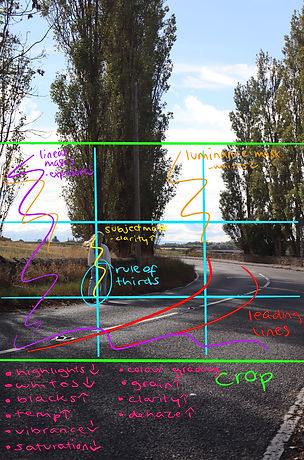

With this image I wanted to remove most of the colour to create a more dramatic atmosphere. With a similar composition to my previous image, the lack of colour or sepia tones in this photo changes the mood to a more melancholic and mysterious one. I think the lack of colour helps emphasise the subject even better against the background and brings out textures otherwise missed. The darker foreground brings attention to the horizon and the storytelling element of where does the road lead? Where is she walking? I also like the subject's hair blowing in the wind, adding a sense of motion to the otherwise still image. However, the central telephone pole disrupts the composition here, separating the image in half, next time I'd better position myself to avoid it being in the centre of the frame. Additionally, the sky in this image is slightly over-exposed as it was sunny during the shoot, so next time I would be more careful to change ISO between locations to match the level of light.


For this version, I aimed to push the mood further into a dramatic and cinematic space. With a higher contrast between the blacks and whites, I think the subject is successfully highlighted here creating a powerful image. However, I'm not sure that the low angle helps the dramatic tone. I think that if I were to do this again, I would shoot this photo from a higher point to achieve a more unsettling and dangerous tone to match the colour scheme and composition.

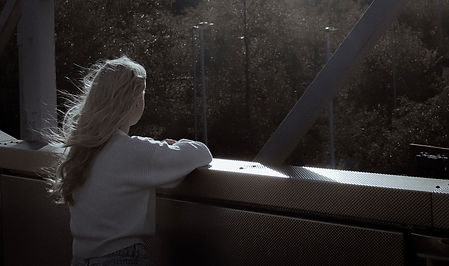
For this image I intended to capture a quieter, more contemplative moment by selecting a bridge location and having the subject look away from the camera into the distance. I think the framing with the rails works well here in making a small intimate and closed in moment. The hair blowing in the wind also adds motion to the photo, enhancing the cinematic tone and storytelling elements as we can infer on the weather and atmosphere. However, the exposure is slightly uneven in this image and the highlights on the railings and bold, taking attention away from the subject and also disrupting the dark image, the background trees are also darker than I intended which flattens the depth. Next time I'd be more careful with making sure I have the right ISO for the setting.

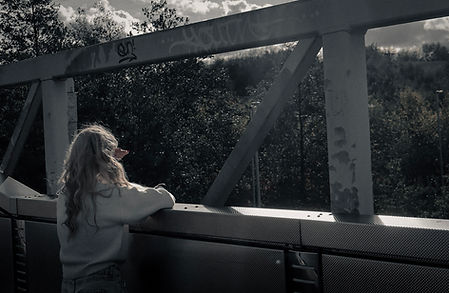


My goal for this photo was to achieve a more reflective mood by selecting a train station location where the subject could sit down to contrast from my other images. My previous photos explore the storytelling idea of journeys with backgrounds of roads and bridges- signifying movement, however, I wanted to capture the moment in between those events, essentially the pause in between journeys and I think waiting at a train station narrates that well. I like the composition of this photo and the added layers of the glass reflection. Additionally, the monochrome palette emphasises the sense of isolation and reflection. However, the background feels a little distracting and cluttered which takes away from the subject, if I did this again, I would experiment with a shallower depth of field to blur out some distracting elements and bring the subject into a sharper focus.


For this image I wanted to capture the anticipation of waiting for something and therefore positioned the subject to the edge of the platform and looking into the distance waiting for the train to come. I think the composition works well, the bridge above frames the shot and adds structure without overshadowing the subject. The black and white colour palette enhances the cinematic vibe and adds a sense of timelessness while reducing any distractions of colour. However, I think this image would've been better in a horizontal aspect ratio for a more stereotypical film still effect. Next time I will make sure to take more landscape photos experimenting with wide angles.
developmental evaluation
I think that this shoot went well as the film stills I have created resemble ones of Sherman and like hers, create more questions than answers. The editing process went well, and I think the colour tones I used match the mood I was aiming for as well as link back to 1950s/60s cinema. However, some negatives include shooting mainly in portrait, not having any props, and not planning any clothing styles. To fix this, next time I would spend more time on a detailed plan, so I would know exactly what to do when shooting and be prepared with any necessary props and equipment. I would also research more into the cinema tropes that Sherman has showcased as although my photos resemble her atmosphere, they do not resemble any stereotypical movies or characters. However, overall, I think this process went well despite the opportunities for improvement next time, and I am happy with the images.
feedback
