
"Mert Alas and Marcus Piggott have collaborated as a photography duo for over 20 years, and in that time have become one of the most distinctive and powerful forces in the fashion industry." - Models.
Mert came from a background in classical music and image retouching, Marcus from styling and set building. This combination can be seen working well today in their signature hyper-polished, dramatic, and seamless photographs.
Rising to prominence at a time when the fashion industry was beginning to embrace digital technology, they became pioneers in integrating early photoshop techniques into their images and practice. Rather than using post production to simply correct an image, they treated it as a creative tool in its own right. Their iconic glossy skin, deep shadows, high contrast, and saturated colour, blurred the boundary between what's real and what's constructed. In doing so, they shifted fashion photography away from naturalism and towards a sort of digital maximalism.
Their work draws heavily on previous eras of high fashion imagery, their images often present women as powerful, hyper feminine figures whose presence is heightened through artifice rather than diminished by it. The idea of femininity as performance, deliberate, constructed, and powerful, sits at the core of their work.
In a technical sense, Mert & Marcus are known for their highly controlled studio environments. They frequently use strong lights and large softboxes to create crisp highlights and defined shadows. This lighting, combined with meticulous retouching, results in an aesthetic that feels polished and cinematic. Their medium format settings capture intense detail that is later amplified in post production.
The project of theirs that I am most interested in is their collaboration with Taylor Swift for her album 'reputation' in 2017. The duo shot the albums key visual campaign, and the imagery became instantly iconic in both Swift's career and also in modern pop culture. Their aesthetic aligned perfectly with the album's themes of public scrutiny, self reinvention, and the performance of identity. Using stark lighting, intense contrast, and their signature hyper polished editing, they created a visual world that felt both confrontational but also meticulously controlled.
"We give birth to the idea together, we shoot together, we’ll swap the camera because we only have one camera on-set. So he might say, ‘give me the camera, I have some angle here that I’d like to try’ and vice-versa." - Mert Alas in Time Magazine
“Their work has moved the goal-posts … Prior to Mert and Marcus, digital retouching was invariably used as a bit of a trick … Mert and Marcus used digital technology in a different way, much more as a hand retoucher would have done — to make the girl perfect.” — The New Yorker.
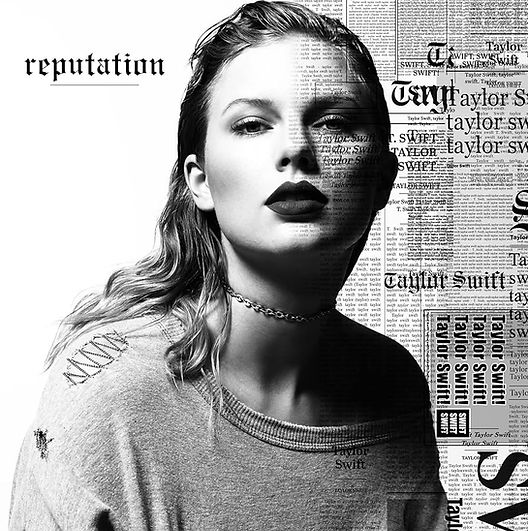
The reputation album cover is one of the most recognisable images of the 2010s and serves as a clear example of Mert & Marcus' ability to combine technical precision with symbolic storytelling. At a technical level, the image reflects many hallmarks of the pair's aesthetic. The lighting appears to be split lighting, casting a strong shadow across half of her face and into her neck, immediately adding depth and definition to the photo. The high contrast creates a dramatic and almost metallic quality to her skin. The monochromatic tone further heightens the sense of severity, stripping the image of warmth and pushing it towards a stark and confrontational tone.
A key element of this image is the lack of catchlights in Swift's eyes. Usually, they create a sense if presence, emotion, and accessibility. By removing them, Mert & Marcus make Swift's gaze appear harsher, flatter, and more impenetrable. Her eyes appear less "alive", aligning perfectly with the albums themes of withdrawal, reinvention, and controlled distance. The missing catchlights therefore function as a powerful symbol of a refusal to perform openness for an audience that has misread her before.
Swift's clothing appears distressed with holes sewn together with metal chains, immediately creating a sense of something torn, wounded, or broken that has been forcibly mended by material that was not originally there, enforcing the idea that she had been torn apart by public criticism and forced to rebuild herself with whatever materials she had left, even if they are sharp and unkind. The necklace also enforces this theme, a thick metal choker sitting high on her neck almost like it is constricting her. Metaphorically resembling a chokehold - the way her voice, narrative, and autonomy were constrained by public scrutiny. All mirroring the theme of the reputation album - the idea that she had been silences, spoken over, and defined by others, to a point of suffocation.
The composition of this image is deceptively simple, but extremely deliberate. Swift is positioned central to the frame but with her body leaning slightly off into a different direction. This immediately created a sense of imbalance while also introducing the idea of momentum, giving her weight presence as she isn't necessarily posing for the viewer, but instead pressing into the viewer's space. It feels like she's approaching us not the other way round, feeling assertive and confrontational rather than passive. Cropping tightly around her face and upper body removes any external context and eliminates and environmental clues. There is no soft background or escape route in the image, instead, she is surrounded by the chaotic typography of her own name which is even merging onto her face. This tight framing traps her inside the narrative the media has built around her - the headlines visually closing in on her. The composition becomes a metaphor for being boxed in by public perception. The negative space is also important. On the left side, the bold album title occupies an area of the frame that visually competes with her face. Normally, a portrait would give the subject dominance, but here Swift has to share her visual space with the word that defines the era- reinforcing the idea that her identity had been overshadowed by the outside narratives and perfectly tying into the album's theme.