
“Rather than control a material, I’m trying to have a conversation with it.”
-Anya Gallaccio


Anya Gallaccio is a British contemporary artist associated with the Young British Artists movement, similar to Sam Taylor Wood. However, unlike many artists who aim to preserve or control their work, Gallaccio actively resists this ideas. She is known for using organic materials such as flowers, fruit, chocolate, and ice, allowing them to naturally decay, melt, or change over time. Her work focuses on transformation, impermanence, and the tension between beauty and deterioration.
One of her most well known works Red on Green (1992). involved thousands of red roses arranged against a wall. At first, the installation appears visually striking and almost romantic, but over time the flowers begin to wilt, darken, and decay. The smell changes, the colour fades, and the overall experience becomes less about beauty and more about the process of loss. Importantly, Gallaccio does not intervene in this process - like artists such as Susan Derges and Andy Goldsworthy, which I have researched for this project - she allows nature to take its course. This lack of control is central to her work, as it challenges the idea that art should be fixed, permanent, or preserved.
Her work is often inspired by natural cycles and the inevitability of change. Rather than representing the ideas symbolically, she presents them physically and in real time. This creates a direct experience for the viewer, who is forced to witness and pay attention to different stages of change. In many ways, her work sits in opposition to traditional art forms, which aim to capture a perfect, unchanging moment. Instead, Gallaccio embraces unpredictability, allowing the materials themselves to determine the outcome of the piece.
What I find most interesting about Gallaccio's work is the way it challenges human ideas of control and preservation. There is often an initial desire to "keep" the work in its most beautiful state, particularly in pieces involving fruit or flowers. However, this becomes impossible, as the materials inevitably deteriorate. This links to the idea that attempting to preserve beauty can actually lead to its destruction, as removing something from its natural environment accelerates its decay. What makes her work distinct is that she does not aim to represent change - she creates conditions where change takes over, suggesting that change is not something that can be avoided or controlled, but something that must be accepted.
I additionally find it interesting how there is an initial sense that the artwork has been carefully and thoughtfully arranged and is therefore stable, but that is quickly undermined as it begins to deteriorate. When visiting an exhibition or gallery, the work presented is usually the final outcome, however the artwork that Gallaccio sets up is only the beginning.
This adds to my sense of wanting to work with nature rather than trying to control it or simply capture it. While my work involves photographing moments, I am increasingly aware that these moments are the result of constantly changing conditions. Experiments such as time lapses could be an interesting approach in my project and help me better collaborate with nature.

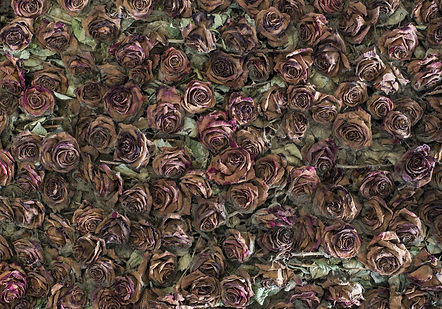
"The lack of control over these processes is really important. I try to let the thing be itself, as, ultimately, the materials are going to do what they want to do. That approach was initially informed by a simplistic notion of gender and feminism. A lot of art history has been about having mastery over a material, with the most successful and famous people in the canon all being men. So, I wanted to challenge that, and rather than controlling a material, I’m trying to have more of a relationship or conversation with it."
- Anya Gallaccio