.jpg)
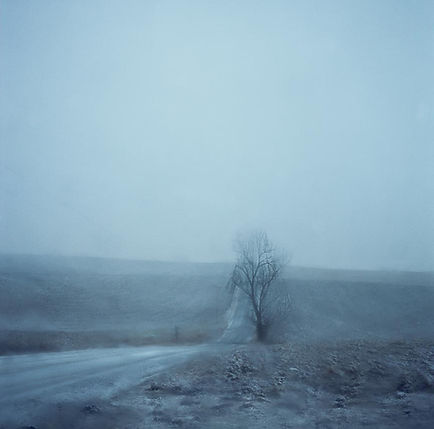

“Although I take pictures all over the country, all the neighborhoods I head towards look similar … All the things I photograph remind me of the home in Ohio I grew up in.”
- Todd Hido
I am familiar with Hido's work having looked into him during my location project, however, after reviewing the outcomes of my fog photoshoot, I noticed clear visual and conceptual similarities that prompted me to research his work and practice in greater depth.
In my previous project, I researched his work with a focus on nostalgia and familiarity within his suburban imagery. At the time, I was particularly drawn to the warm colour palettes, hazy atmosphere, and the way his photographs felt familiar and inviting. I was interested in how his images could exist almost anywhere, allowing the viewer to project their own memories onto the scene and experience a sense of familiarity without specific context.
Revisiting Hido's work this time, I began to interpret his imagery differently. Rather than nostalgia, I became more aware of the sense of absence and emotional distance present in his photographs. The cinematic quality of his work, combined with obscured visibility and withheld narrative, positions the viewer as an outsider - able to observe, but never fully access the scene. This shift in interpretation is not due to a change in Hido's work, but in my own perspective and focus, which I find interesting to highlight as it reinforces how his images invite emotional projection and allow the viewer to hold a storytelling role with his interpretive style. Ultimately emphasising the idea that meaning in photography is not fixed, but shaped by the viewer's emotional state, context, and intentions.
Best known for his atmospheric images of suburban landscapes, empty houses, roads, and interiors, often photographed in low light, fog, rain, or snow. Hido's work frequently evokes feelings of isolation, melancholy, and emotional distance, using environment as a psychological base rather than focusing on people directly.
Hido's photography is largely concerned with mood and suggestion rather than documentation. His images often feel cinematic, as though they exist within an unresolved narrative. "As an artist I have always felt that my task is not to create meaning but to charge the air so that meaning can occur" - Todd Hido. A strong influence on his work is film, particularly movies with strong atmospheric tension and unresolved narratives. He has referenced filmmakers such as Alfred Hitchcock and David Lynch as influences, especially in the way their work creates unease through setting rather than action. This cinematic influence is evident Hido's use of lighting, framing, and mood, where scenes feel like stills taken from a story that is never fully revealed.
The absence of visible figured is a recurring feature in his work, yet there is a constant implication of human presence - lights glowing behind windows, tire tracks on roads, or houses that appear occupied but inaccesible. This tension between presence and absence is central to his practice and encourages the viewer to project their own emotions and assumptions onto the image.
Another key influence on Hido's practice is the idea of voyeurism and distance. His recurring use of windows, darkness, fog, and rain reflects an interest in looking without fully accessing. The viewer is positioned as an observer who is close enough to feel involved but too distant to truly understand what us happening. This limitation of insight is intentional in his work and something I plan to attempt in my own.
Technically, Hido often uses natural, low light conditions and embraces visual limitations such as fog, darkness, and shallow depth of field. These elements reduce clarity and detail, softening the scene and preventing the viewer from fully accessing it. Rather than presenting a clear or objective view, his work prioritises atmosphere and emotional ambiguity, reinforcing the idea that perception is incomplete and subjective. He has worked with multiple cameras over the years, working extensively with film cameras in his early career, specifically medium format styles helping him capture deep tonal range and detail. He still continues to use film currently while also combining this with digital. In interviews he has explained he started with 35mm but later incorporated digital cameras, especially for ease of use in low light. He has said he wanted digital output that looked like his film work.
Hido's work strongly connects to my fog photoshoot, particularly in the way both practices use environmental conditions to obscure information and create emotional distance. In both cases, the viewer is positioned as an outsider, able to see fragments of a scene but never fully understand it.
Conceptually, Hido's exploration of isolation and unknowability aligns closesly with my broader project theme of absence and limited insight. Both works resist clear answers or explicit storytelling. Researching Hido more deeply has helped me contextualise my own work within a wider photographic topic about atmosphere, emotional projection, and the idea that some spaces, and people, can be observed but never fully known.
“Photography is the thing I use to express myself, or to figure myself out. It’s very much led by intuition.”
- Todd Hido
…they suggest untold tales and possibility. The suggestions are as much yours as they are Hido’s…”
- The New Yorker
“Things look strange when you’re a stranger… In Hido’s photographs, the vague presence of men can be felt… Through lit windows, footprints on snow, and the thriller-like atmosphere…”
- Medium

I particularly like this image depicting a solitary suburban house, partially obscured by fog. The surrounding environment is quiet and empty, with no visible figures present. A single window emits a warm yellow light, contrasting strongly against the cool, muted tones of the fog, road, and landscape. The house appears isolated, set back from the viewer across the road that creates physical and psychological distance.
The fog softens edges and reduces clarity, causing the house to feel suspended in space, feeling still, almost frozen, as if time has paused.
Compositionally, the house is placed off centre, preventing a sense of balance or comfort. The road in the foreground acts as a barrier, separating the viewer from the house and reinforcing the idea of distance and inaccessibility. Leading lines are subtle but present, guiding the viewer's eye from the dark foreground toward the illuminated window.
The frame is dominated by negative space - the dark road and fog filled sky occupy a lot more of the image than the house itself. This imbalance heightens tension and gives the impression that the environment is overwhelming the subject rather than supporting it.
The shallow visibility caused by the fog removes background detail, flattening the space and making the scene feel claustrophobic despite being outdoors.
Light feels like the emotional anchor of the image. The warm glow from the window contrasts sharply with the cold, desaturated tones of the surroundings. This creates a visual and emotional tension. The light suggests comfort, safety, or human presence, while the fog and the darkness suggest isolation, uncertainty, and distance.
Hido's restrained colour palette avoids vibrancy, instead relying on muted blues, greys, and greens. This subdued palette enhances the melancholic tone and prevents the image from feeling romanticised. The warmth of the light feels fragile, small, contained, and easily swallowed by the surrounding darkness.
Technically, the image appears to be shot in low light using a long expsoure, allowing detail to emerge from the darkness without harsh artificial lighting. The fog acts as a natural diffuser, softening the contrast and reducing sharpness, which removes any sense of documentary reality.
Depth of field is controlled to keep the house readable while allowing the surrounding environment to fall away into softness. Grain and tonal subtlety suggest and intentional sense of imperfection, reinforcing the emotional rather than factual nature of the image.
Natural light is prioritised, with the interior light becoming the only illumination source, placing narrative emphasis on what is unseen inside the house rather than the external environment.
Semiotically, the house functions as a signifier of domestic life, safety, and familiarity. However, its isolation and lack of visible occupants destabilise these associations. The lit window signifies presence, but the absence of figures denies the confirmation, creating ambiguity.
The fog also operates as a signifier of uncertainty and limited knowledge. It prevents the viewer from accessing the full context of the scene, mirroring emotional or psychological barriers. The road symbolises separation - the viewer is positioned as an observer who cannot cross into the space.
The image appears to be shot from a slightly low angle, positioning the viewer below the house rather than at eye level. This subtly alters the power dynamic of the image, instead of feeling invited into the space, the viewer is made to feel smaller and more distant, reinforcing a sense of separation and emotional exclusion. The house takes on a looming quality, not through scale alone but through its inaccessibility, as though it exists just beyond the viewer's reach.
The framing further contributes to this feeling of detachment. A tree partially intrudes into the left side of the frame, acting as a visual barrier rather than a decorative element. This creates the impression that the viewer is observing the house from an obstructed view, heightening the sense of voyeurism often associated with Hido's work.
Additionally, the house is not fully contained within the frame. By allowing parts of the structure to extend beyond the edges, Hido denies visual completeness. This lack of closure prevents the image from feeling resolved or stable, mirroring the conceptual themes of absence and limited knowledge. The viewer is given only fragments of information, reinforcing the idea that the space, and whatever may exist inside it, can never be fully understood.
Rather than offering answers, the image invites projection. Meaning is not fixed but constructed by the viewer, shaped by their own memories, emotions, and assumptions. This aligns with Hido's broader practice of creating images that "charge the air" with emotion rather than delivering explicit narratives.