Cyanotypes

Cyanotypes were invented in 1842 by Sir John Herschel, not as an artistic process but as a scientific one. Herschel was experimenting with light-sensitive chemicals and trying to find a simpler way to copy notes, diagrams and observations without having to redraw them by hand. Unlike many early photographic processes, which relied on expensive silver salts, cyanotypes used iron compounds that reacted to UV light. When washed in water after exposure, the image developed into a "blueprint". This made the process far cheaper, more accessible and easier to use than other methods at the time.
Because it was so simple, cyanotype was one of the first photographic processes that could be used without specialist equipment. Paper could be coated by hand, objects placed directly onto it, and then exposed in sunlight. Some of Herschel’s earliest cyanotypes were contact prints and photograms, including his well known 'Lady with Harp', which showed how accurately the process could capture shape and detail. What is interesting is that Herschel himself did not really treat cyanotypes as a major artistic breakthrough. At the time, he was more interested in finding ways to fix photographic images and improve scientific reproduction. Cyanotypes were initially seen more as a useful tool than as a creative medium.
The process did not immediately become hugely popular in fine art, partly because early photography was developing so quickly and other processes were considered more refined. Cyanotypes were often seen as too basic or too limited because of their single blue tone. However, what helped them catch on was practicality. They were cheap, reliable and easy to reproduce. By the late nineteenth century, cyanotypes became widely used in architecture and engineering to copy plans and technical drawings, which is where the term “blueprint” comes from. This practical use meant cyanotypes remained relevant long after many other early processes became outdated.
What I find most interesting about cyanotypes is that, even though they began as a scientific process, they naturally lend themselves to chance and experimentation. The final image depends on sunlight, exposure time, weather and the objects or materials used. That unpredictability makes them feel very relevant to my own project, because my work is also about observing change and working with natural processes rather than trying to fully control the outcome.

Sir John Herschel
Lady with Harp
1842
Anna Atkins

“The difficulty of making accurate drawings of objects as minute as many of the Algae and Confera, has induced me to... obtain impressions of the plants themselves.”
Anna Atkins
Anna Atkins was one of the first people to recognise that cyanotypes could be used for more than just scientific copying. In 1843, only a year after Herschel invented the process, she began using cyanotypes to record algae, seaweed and plant specimens. Atkins was already a botanist and scientific illustrator, so she understood how important accurate visual records were. At the time, scientific books usually relied on engravings or hand-drawn illustrations, which could be idealised or slightly inaccurate. Cyanotypes offered something much more direct: a way to let nature leave its own trace.
Her most important work, Photographs of British Algae: Cyanotype Impressions, is widely considered the first book ever illustrated with photographic images. She began publishing it in 1843 and continued releasing parts over the next ten years. The project included hundreds of individual cyanotypes, each made by placing dried plant specimens directly onto sensitised paper and exposing them to sunlight. The result was incredibly detailed white silhouettes against blue backgrounds, showing every vein, stem and texture.
What makes Atkins so important is that she helped shift photography away from being seen purely as a scientific invention. Her work still had a practical purpose, but it also had a clear visual sensitivity. The compositions feel delicate and considered, and the blue tone gives the images a softness that almost makes the plants look suspended in water. She did not start an art movement in the formal sense, but her work laid the groundwork for photography being understood as both documentary and expressive. A lot of contemporary cyanotype artists still reference her work because of the way she merged process, nature and preservation.
Personally, the thing that draws me to Atkins’ work is how she preserved something temporary. Plants naturally change, decay and disappear, but her cyanotypes hold onto a moment of them. That links strongly to my own project, where I am also looking at how photography can draw attention to things in nature that are constantly shifting and temporary.

Henry Peter Bosse

"While many of his photographs document the interplay between the natural and the manmade, in this tranquil image, Bosse emphasizes sky and water, evoking the immensity and utter expansiveness of a subject that seems to have no bounds."
-The Met
Another important cyanotype artist I looked at is Henry Peter Bosse, who used the process in a completely different way. While Atkins focused on small natural details, Bosse used cyanotypes to photograph the Upper Mississippi River in the late nineteenth century. His images documented riverbanks, bridges, engineering structures and changing landscapes during a time of major industrial development.
What makes Bosse’s work interesting is that it shows cyanotypes developing beyond flat photograms and scientific samples into atmospheric landscape photography. The blue tones work especially well with water, sky and distance, giving his images a calm but slightly eerie quality. Even though his work had documentary value, it still feels expressive because the process itself affects the mood of the image.
His work is relevant to me because it explores environmental change on a wider scale. He documents the relationship between nature and human intervention, which links closely to ideas in my own project about permanence, change and the way landscapes shift over time.


Although cyanotypes became less common as photography developed, the process has had a strong revival in contemporary art. In a digital age where photography is usually instant and controlled, cyanotypes appeal to artists because they feel slower, more physical and less predictable. Rather than just capturing an image, the process involves direct interaction with materials, sunlight and time.
A contemporary artist who uses cyanotypes in a way I find really interesting is Meghann Riepenhoff. Instead of simply placing objects on paper, she takes prepared cyanotype sheets into natural environments and exposes them directly in waves, rain and wind. This means the ocean, weather and movement physically shape the image. Her work pushes cyanotypes even further into collaboration with nature, making the process itself part of the artwork.
This is what makes cyanotypes feel so relevant to my project. My work is focused on change in nature and how much happens around us that we barely notice. Cyanotypes fit that idea perfectly because they rely on natural conditions and unpredictability. Rather than forcing an image, the process allows nature to leave its own mark, which feels much more honest and in line with what I want my project to explore.

Meghann Riepenhoff
Littoral Drift Nearshore #209
2015
My Experimentation
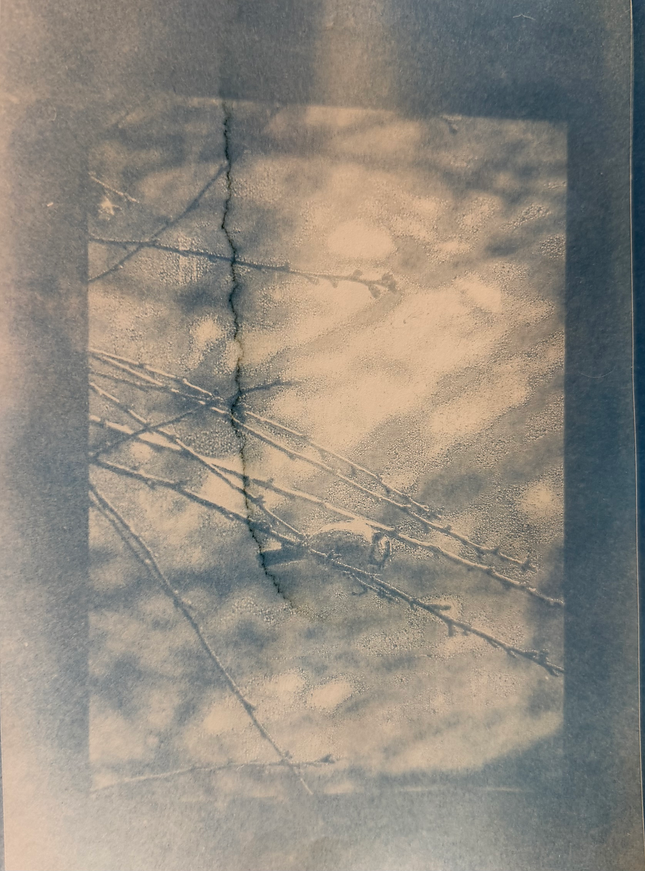
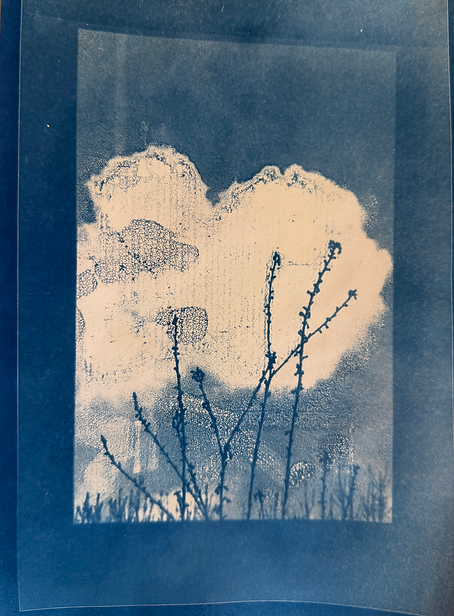
When experimenting with my own cyanotypes, I used pre coated light sensitive paper to explore a more hands on and process based approach to image making. I worked with both natural sunlight and a UV lamp to compare results and understand how exposure time affects the final outcome.
The UV lamp offered more control and flexibility, allowing me to produce prints at any time of day and in any conditions. Through testing, I found that an exposure time of around 6 minutes produced the strongest results. I started with exposing the paper for around 10 minutes however that left the images with no detail and just solid light and dark areas, I then shortened the exposure time drastically to 2.5 minutes where I found the image just faded when I was washing the chemicals off and so I landed on the time of 6 minutes.
In contrast, the sunlight required 10-12 minutes, depending on the conditions and intensity. While the sun allowed me to produce multiple prints at once, it was less predictable due to environmental factors. The UV lamp, although slower as I could only do one at a time, created more consistent and reliable outcomes and so I used that for the majority of the prints.
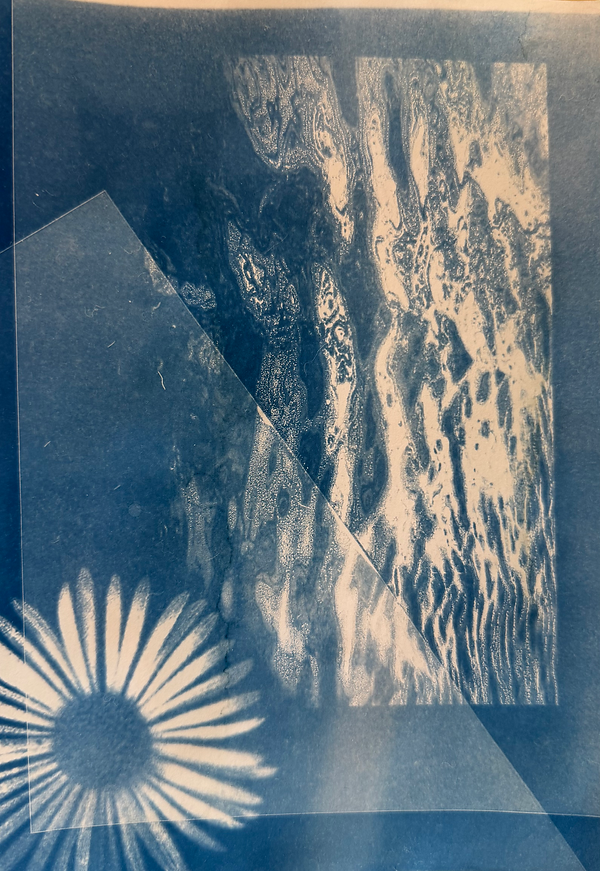
I experimented with a range of subject matter. I used photoshop to invert and increase the contrast on my images to print them onto acetate. These worked well conceptually, as they brought my existing imagery into a more physical and tactile form. The cyanotype process gave these images a different quality - the deep blue tones enhanced elements such as water and sky, reinforcing their natural atmosphere.
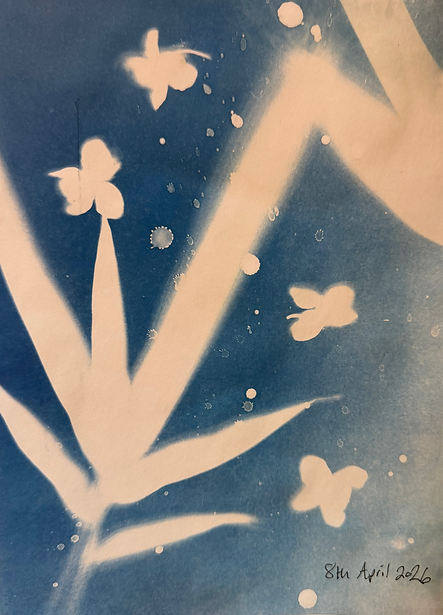
Alongside this, I also used physical plants and flowers. I arranged them directly onto the paper and exposed them, then repeated the same compositions 2 days later using the same plants. This allowed me to document subtle changes in their structure and form over time. I found this particularly interesting as it visually captured early stages of decomposition - something that aligns closely with my theme of change. The differences were small but noticeable, reinforcing the idea that change is constant, even when it isn't immediately obvious.
This process felt similar to my previous mixed media experiment in that it positioned me more as a collaborator rather than just an observer. I had to respond to variables such as exposure time, light source, weather conditions, and the physical state of the plants. This unpredictability made the process more experimental and engaging, and it reflects my intention to work with nature rather than document it.
If I were to develop this further, I would extend the timeframe of the plant studies, potentially creating a series that tracks their decomposition over a longer period of time. This would allow the idea of change to becomes more pronounced and visible.
However, I do not think I will carry this technique forward into the last few weeks of this project. While the cyanotypes process is visually striking, the limited blue colour palette restricts what I want to communicate. A key direction in my project is focusing on natural colour and how that can also shift, which cyanotypes do not allow for. Additionally, although detail can be captured through this process, I feel that digital photography will allow me to achieve a higher level of precision and control, particularly when focusing on very fine details.
Overall, this experiment was valuable in helping me explore a more physical and collaborative way of working, and it strengthened my understanding of how change can be captured through both process and subject matter.